Our Sixteenth Newsletter | Popular Wild Honey Variety Finally Back in Stock | Wild Honeycomb Also Back | 20th Anniversary | New Gift Packs and Four Packs Released Today for Festive Season | Beekeeping Updates and more |
|
~•*•~
'The bush with softly waving lights; and bees Keep up a monotone, a murmuring'
Retreat, 1940 - 1947
Francis Webb
|
|
Dear Friends,
We hope this missive finds you thriving as we head toward the end of another eventful year.
This month marks the 20th anniversary of our humble, artisan business becoming official, and the birth of the Malfroy's Gold honey label. The journey so far has been long and challenging at times but entirely worth it as we love to share our award winning produce and our passion for bee health, natural resilience and sustainability with our ever supportive customers.
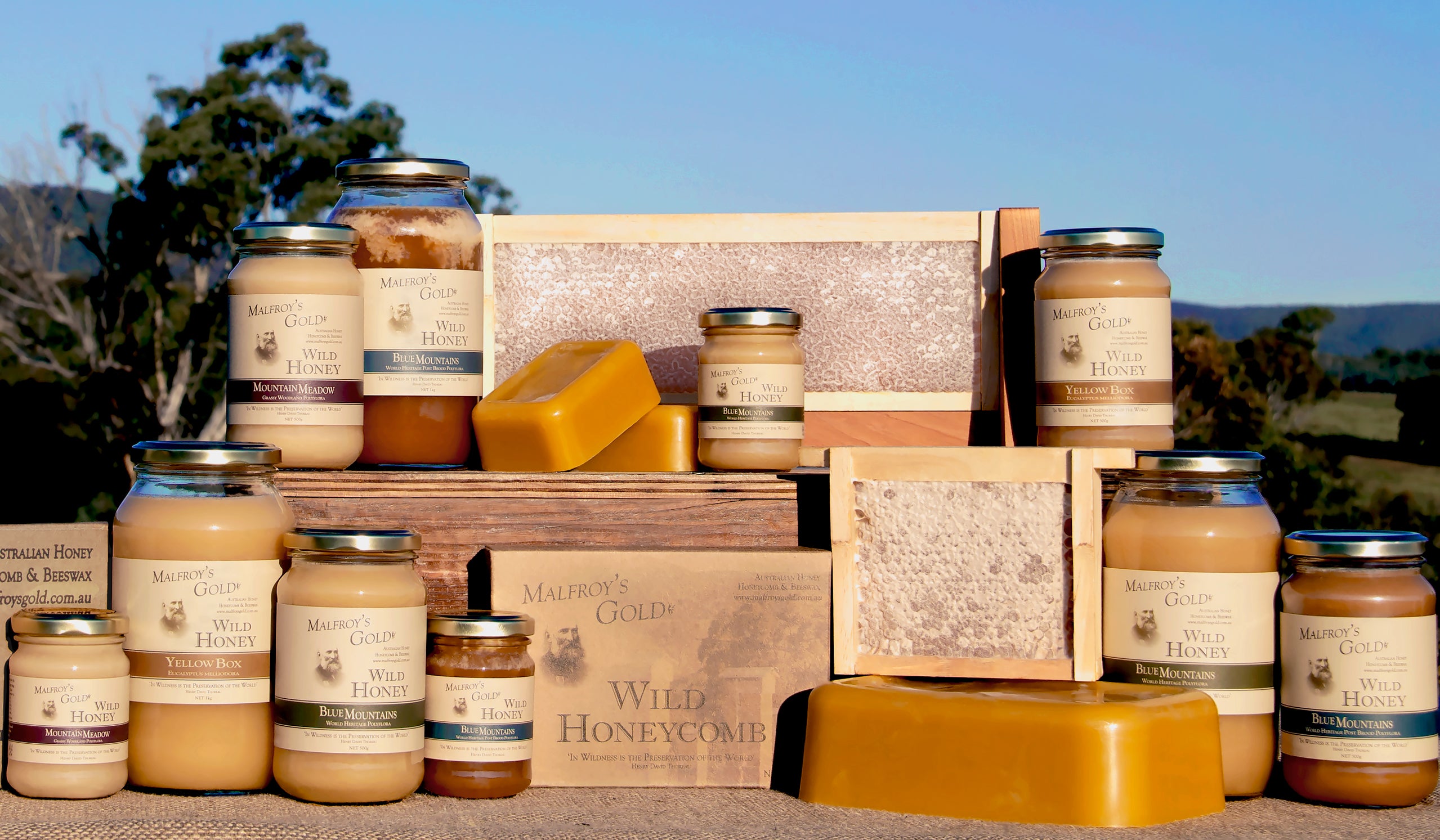
To celebrate this major milestone we are releasing a rare Polyfloral variety of Wild Honey today in a number of jar sizes, four packs and gift packs. Our incredibly popular Wild Honeycomb is back in stock as well - just in time for the festive season!!
Tim will discuss his commitment to keeping bees naturally and the pioneering work he is currently doing in that area, and also update us on the start of the season for 25/26.
Happy reading!
PS. If you didn't see this in our last missive and you’re using an iPhone, there have been a few changes to Apple's Mail app. If you are using the new "Categories" view in Apple Mail, please open our newsletter email, tap the  (More) button at the top of the message list, then choose "Categorise Sender" to move us to your Primary tab to make sure you keep receiving our newsletters. (More) button at the top of the message list, then choose "Categorise Sender" to move us to your Primary tab to make sure you keep receiving our newsletters.
|
|
Mountain Meadow Grassy Woodland Polyflora is Back
'There’s a botanical and almost ‘good medicine’ feel to this honey' * |
|
We are excited to release the Polyflora line of our Mountain Meadow harvest this week, a customer favourite and one of the few light coloured Wild Honeys we produce. As with it's post-brood counterpart (that was released in our last newsletter), there are only a few hundred jars available, and in limited sizes/packs - once sold out, this rare variety might not appear again for 5 years!
This pure Australian Wild Honey is produced from 100% natural comb in bee-friendly Warré apiaries in the high altitude woodlands of the Central Tablelands in NSW.
|
|
If you received our previous newsletter you may recall that unique environmental conditions contributed to the flavour profile of our current Mountain Meadow honey.
If you didn't, in summation, in the lead up to the bee season of 2025, the Central Tablelands had suffered through drought, prolonging the growth and budding of Eucalypt tree species so there was no tree blossom for bees to forage over the warmer months. This is unusual as most honeys in Australia are dominated by the ubiquitous flowering Eucalypts (of which there are over 800 species in nearly all bioregions across the continent).
Instead, when the drought finally broke the rains that fell on parched ground triggered a flowering of ground flora species that are rarely seen resulting in a Wild Honey flavour profile quite unlike any of our other honeys. This is only the second time in 15 years we have produced this variety.
|
|
' Flavours: Dried citrus, woody spices, lanolin, caramel biscuits, sugared arrowroot biscuits, glazed nuts. Sweet, pretty, textural. There’s a delicacy to the flavour profile and overall experience, though that is countered by the ‘spoon-stands-up-in-this’ richness to texture. There’s a botanical and almost ‘good medicine’ feel to this honey. To be eaten from the jar. Colour: Golden sandy colour, tiny brown flecks Texture: Rich treacle. Creamy. Granular. Aromas: Dried tropical fruits, ginger, lemon myrtle, strawberry gum, highly botanical, alpine flowers, paperbark' * Mike Bennie, Australian Writer, Public Speaker and Wine Journalist, Instagram: @mikebennie101 |
|
Our unique Mountain Meadow Polyflora Wild Honey is very limited and will be popular with chefs and customers alike - particularly as the festive season is upon us - so be sure to order some now! |
|
Our very small, family run business has just turned Twenty!! Time certainly flies when you are having fun but over such a long period you inevitably experience some upheaval and hardship as well.
During that score of years we have had some amazing opportunities and support thrown our way by incredible chefs and talented people in the food industry which has helped us stay positive and focused on achieving our vision: to keep bees as naturally as possible and produce the highest quality bee produce in Australia.
Keeping our operation so small (it is still literally only the two of us doing everything) has been very challenging, but over time we, the bees, our beekeeping methods, and our business model, have grown more resilient to better combat adversity and adapt to change.
To commemorate this anniversary, we have included a few memories that make up a small part of our story and cover some of the major changes and developments that have occurred over the last two decades - all which have helped our honey label become a well respected and trusted brand in Australia. |
|
Twenty years ago, Tim (having grown up in a beekeeping family and working in his father 's commercial beekeeping operation at the time), decided to try managing his own hives and producing his own honey. What started out as a small venture (comprising only two langstroth hives) soon blossomed into a very small business selling the pure mono-varietal Australian honeys Tim and his Dad were producing. |
|

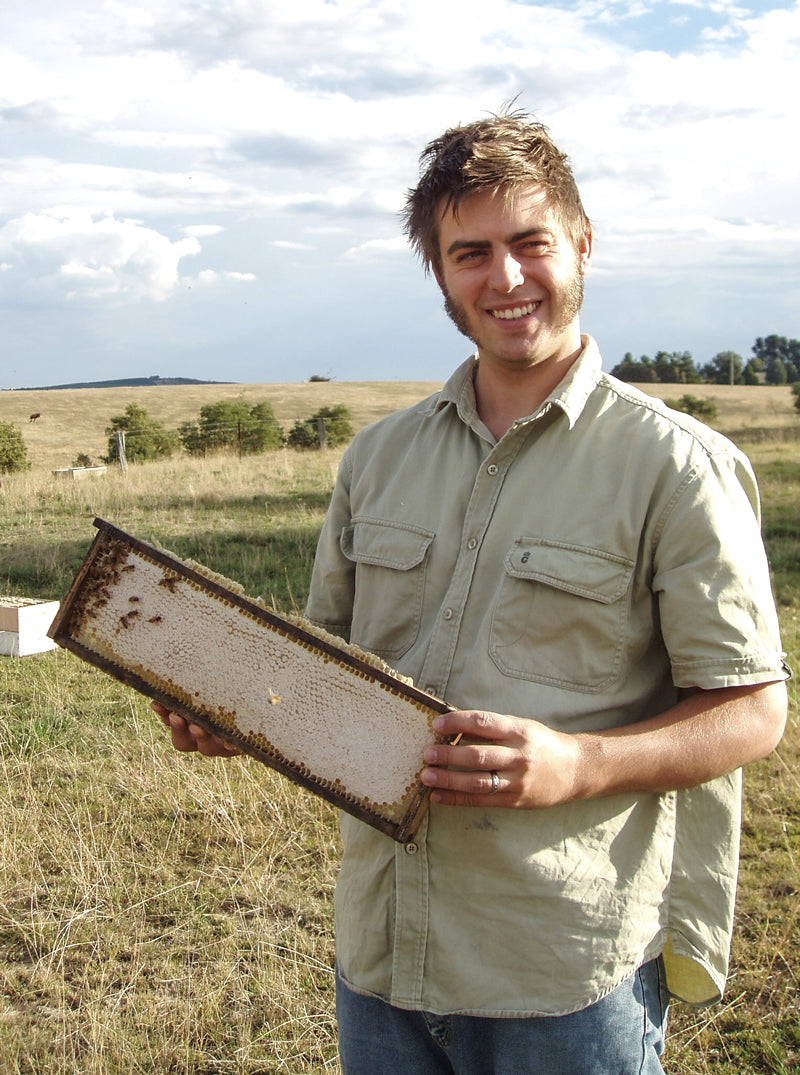
Tim holding one of the first full frames of honeycomb produced by his two Langstroth hives (mid 2000's)
|
|

Tim holding up one of his first open frames of Wild Honeycomb produced in our first, tiny home Warré apiary (2011)
|
|
|
|
|
|
|
Tim holding one of the first full frames of honeycomb produced by his two Langstroth hives (mid 2000's)
|
Tim holding up one of his first open frames of Wild Honeycomb produced in our first, tiny home Warré apiary (2011)
|
|
|
About 3 years later Tim investigated a more natural beekeeping method that favoured bee health over intensive honey production. He researched the French Warré method which was far more bee centric and favoured sustainability over output. He was instantly hooked so he and Emma attended the Apimonida conference in Montpellier in 2009 to take part in the small presentation on Warré beekeeping. There they met the very few people practicing it around the world. To say he was sold on the idea after that would be an understatement! |
|

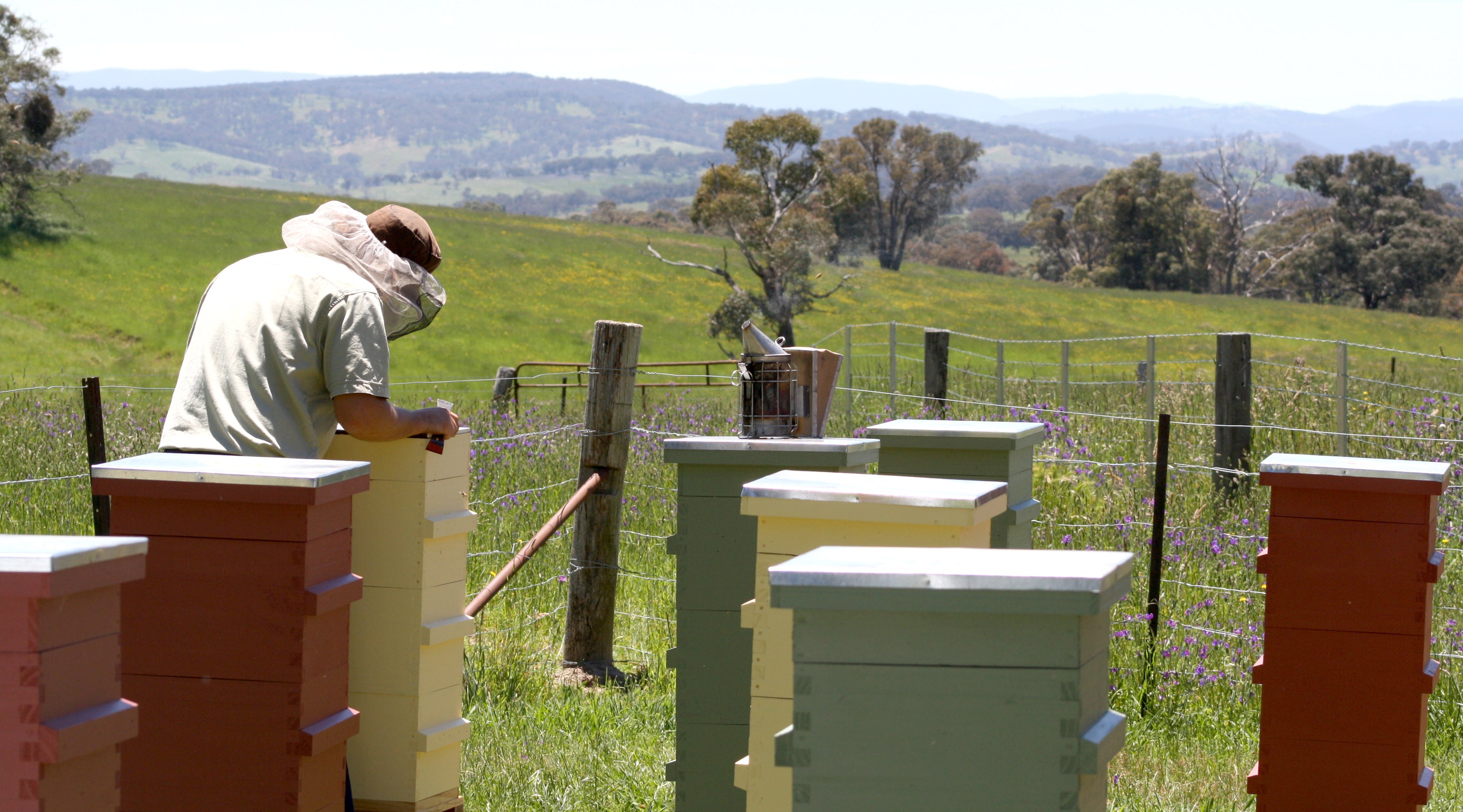
Our first Warré apiary in the high altitude Central Tablelands, (2010)
|
|

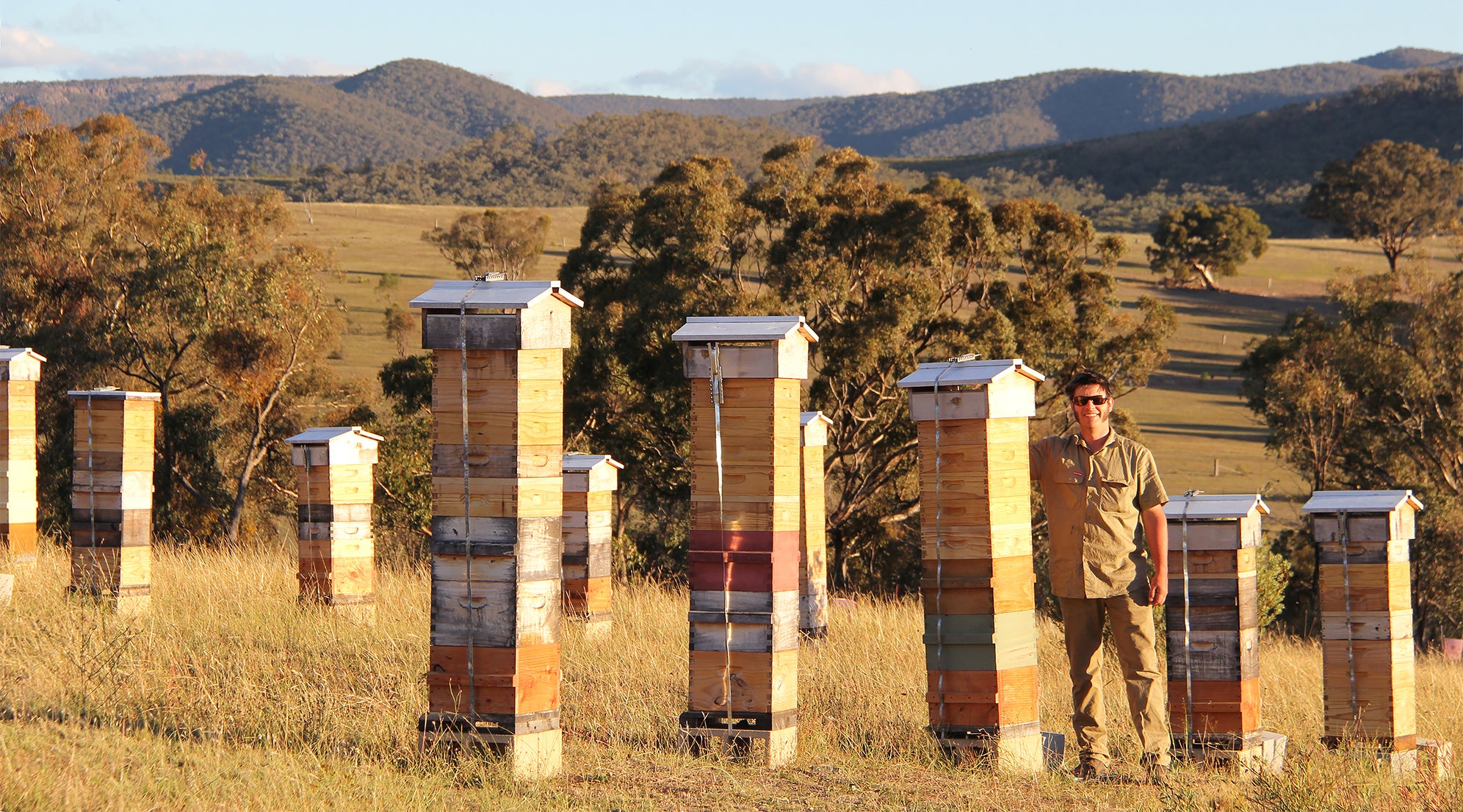
After nearly 10 years of hard work and patience, Tim stands in our biggest Warré Apiary in the Central Tablelands (2019)
|
|
|
|
|
|
|
|
|
After nearly 10 years of hard work and patience, Tim stands in our biggest Warré Apiary in the Central Tablelands (2019)
|
|
|
On returning home he immediately built two Warré hives and then slowly adapted them to Australian conditions over time. He found that his adapted Warré system produced happier and healthier bees as well as much purer and tastier honey (as the bees build their own comb). After about 5 to 10 years he grew the Warré hive numbers from 2 to 300 in apiaries dotted around the Central Tablelands and Blue Mountains World Heritage listed wilderness. |
|

Our original product range as it was in 2016
|
|

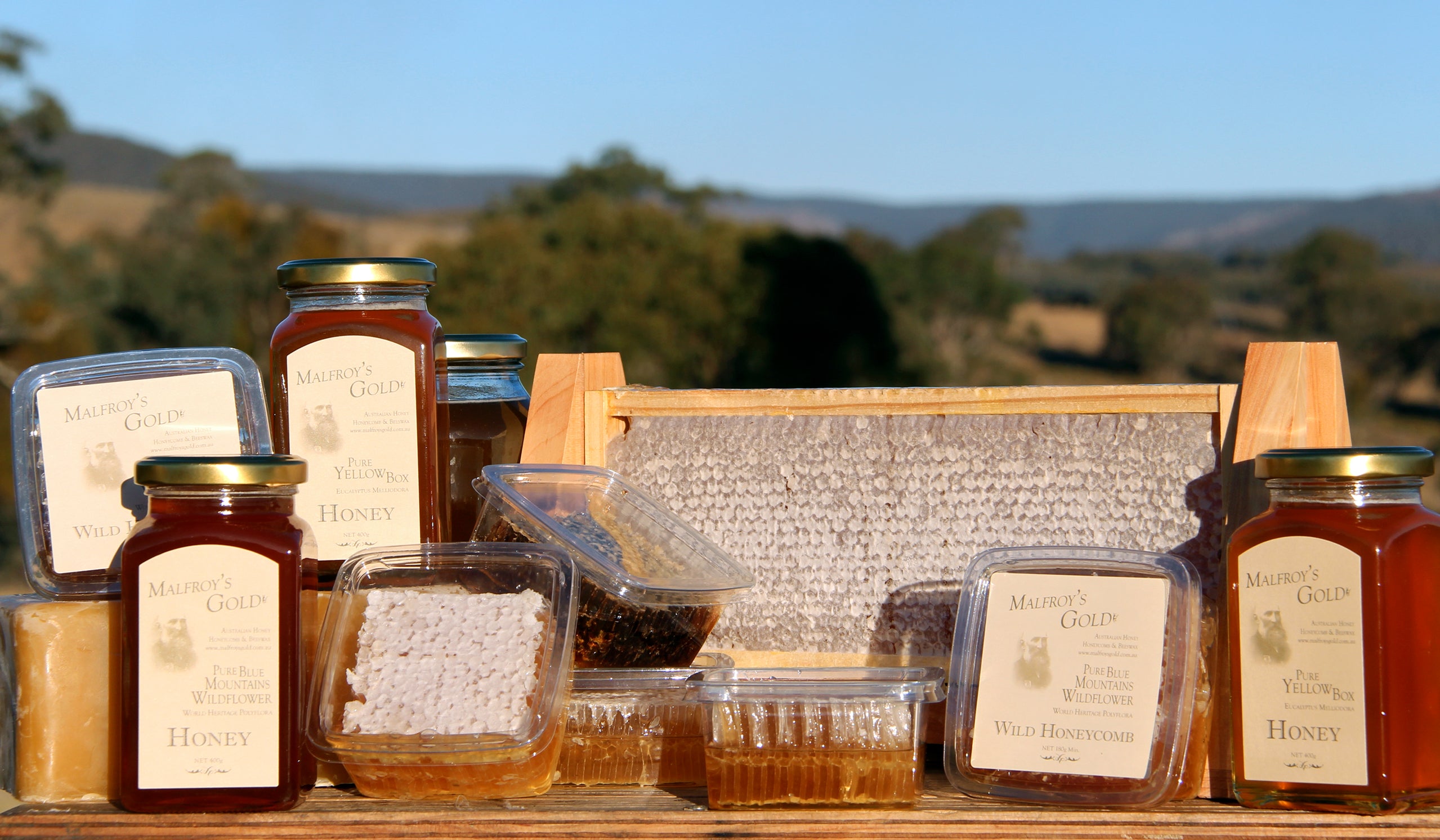
One of our largest Wild Honey product offerings (2021)
|
|
|
|
|
|
|
Our original product range as it was in 2016 |
One of our largest Wild Honey product offerings (2021)
|
|
|
The next major development was Tim's discovery of a kind of honey no-one had produced from Warré hives - it was so new he had to coin a term for it and thus our Post Brood Wild Honey was born. This product was a real turning point for Malfroy’s Gold as chefs and food enthusiasts were immediately blown away by its complex flavour and health benefits.
|
|

Our award winning Blue Mountains Post Brood Wild Honey (© Chris Court 2020)
|
|
|
|
|
|
|
|
|
Our award winning Blue Mountains Post Brood Wild Honey (© Chris Court 2020)
|
|
|
This lead to the finest restaurants in Australia championing our produce and our work was noticed and rewarded at the highest levels (.delicious medals and trophies, Clare Smyth - the best female Chef in the world - using it in her Australian restaurant Oncore, our produce being featured on Masterchef). |
|
 Tim selling our wares at the Blackheath Farmers Markets (c. 2007). For approximately 8 years we sold our Honey Bee Produce at those wonderful markets Tim selling our wares at the Blackheath Farmers Markets (c. 2007). For approximately 8 years we sold our Honey Bee Produce at those wonderful markets |
|

The illustrious Clare Smyth, chef to English royalty amongst others, visiting our Upper Blue Mountains Apiary to sample our Post Brood Wild Honey in it's natural environment (© Oncore)
|
|
|
|
|
|
|
Tim selling our wares at the Blackheath Farmers Markets (c. 2007). For approximately 8 years we sold our Honey Bee Produce at those wonderful markets |
The illustrious Clare Smyth, chef to English royalty amongst others, visiting our Upper Blue Mountains Apiary to sample our Post Brood Wild Honey in it's natural environment
|
|
|
So, in a nutshell, we have achieved quite a lot from very humble beginnings and with very little at our disposal. We couldn't have done it without our incredible bees, pristine Australian landscapes and the support of bee scientists, family, friends, the leading lights in the Australian food industry and our amazing customers. |
|
 Tim and Emma in 2005 when they registered the Malfroy's Gold Business together (one year before getting married!) Tim and Emma in 2005 when they registered the Malfroy's Gold Business together (one year before getting married!) |
|

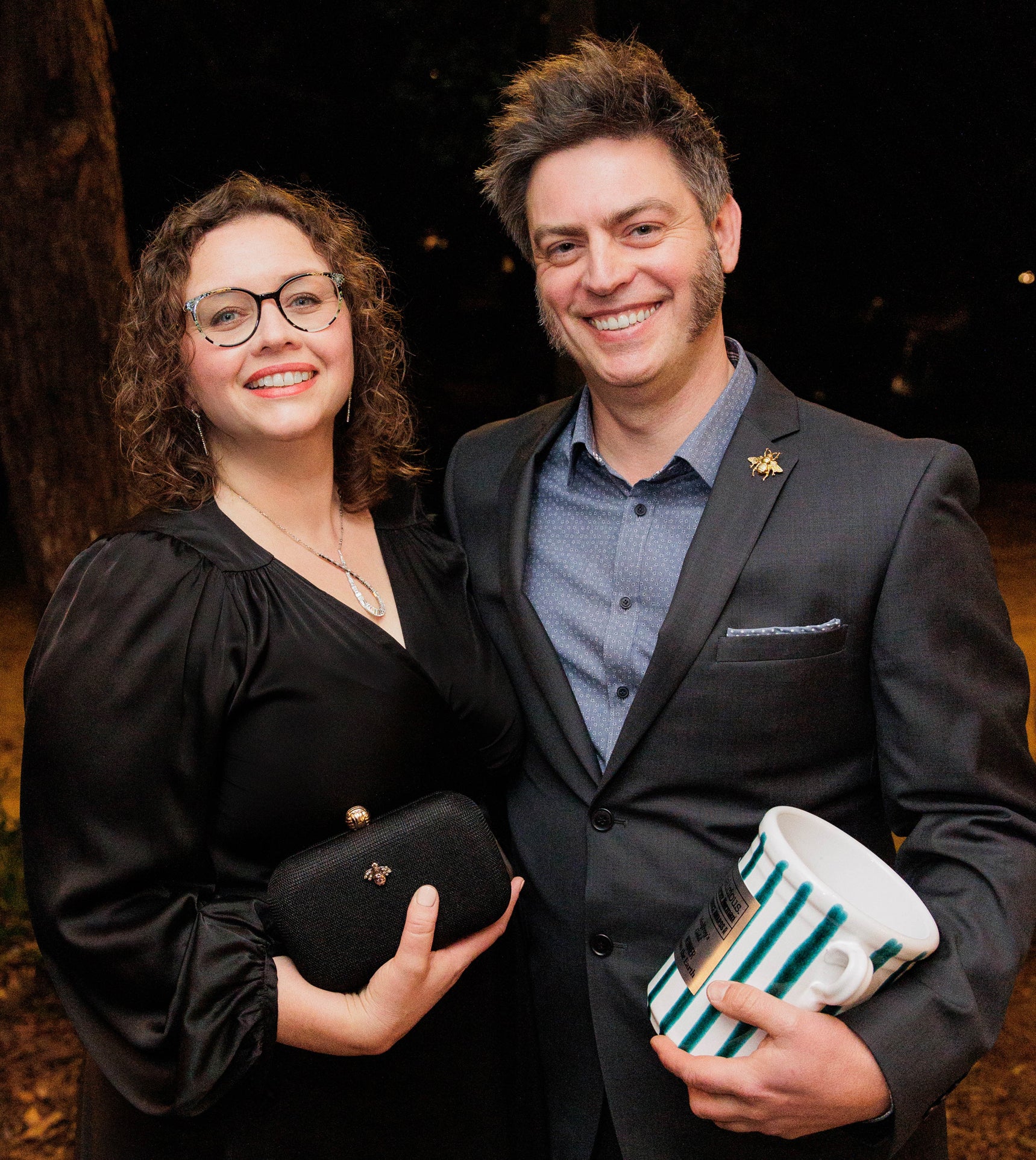
Tim and Emma at the .delicious Produce Awards in 2024 where they were awarded the Nationa Trophy in the From the Earth category
|
|
|
|
|
|
|
Tim and Emma in 2005 when they officially registered the Malfroy's Gold business (one year before getting married!) |
Tim and Emma at the .delicious Produce Awards in 2024 where they were awarded the National Trophy in the From the Earth category
|
|
|
From the bottom of our hearts (and thoraxes) we thank you all! |
|
As our bees' health and survival takes precedence over yield, and due to various extreme weather events impeding our honey production, we were unable to produce any Wild Honeycomb last season. As a result, we have been inundated with enquiries as to its next availability.
You will be happy to know that the wait is over!
|
|
Our very popular 300g Wild Honeycomb sections are now finally back in our online shop - though numbers are very limited so you will need to grab them while they last. We also have some beautiful 750g Wild Honeycomb frames which are great for cheese platters, desserts or entertaining larger groups during this festive time of year. |
|

Our beautiful bees building the purest Wild Honeycomb in the Blue Mountains wilderness
|
|

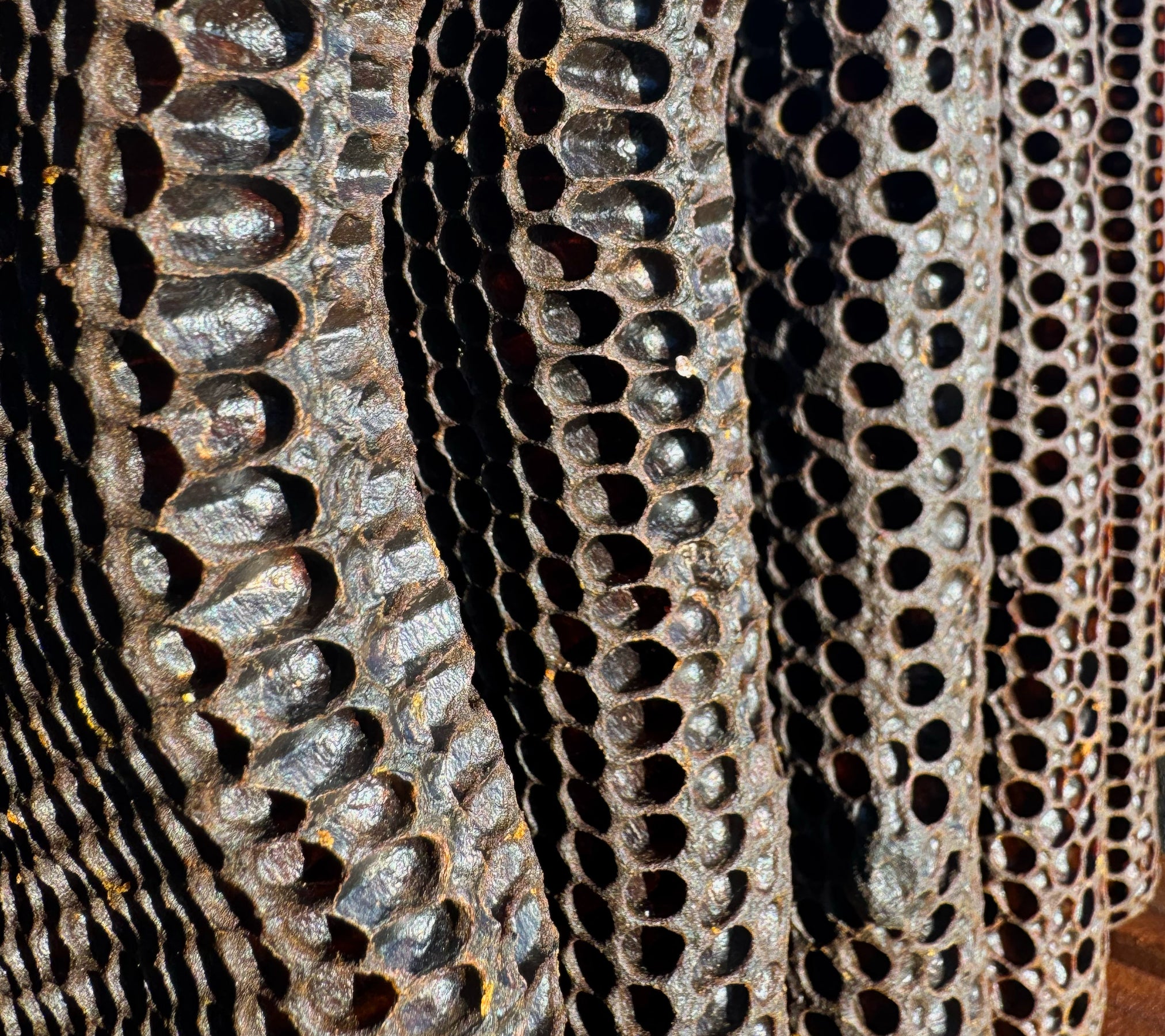
Close up of uncapped Wild Honeycomb cells
|
|
|
|
Chefs in some of Australia's finest restaurants are snaffling it up as we type - so be sure to order some now! |
|
We’ve survived bushfires, floods and a pandemic, but the parasitic Varroa mite is the biggest threat to Honeybee colonies worldwide and our greatest challenge to date (photo © Eric Tourneret)
|
|
As you might be aware from reading our newsletters over the past few years, the parasitic mite Varroa destructor has decimated honeybee colonies in Australia since arriving in June 2022.
As a critical pollinator of food crops, pastures and native plants, the widespread collapse of honeybee colonies is alarming (although grimly expected by those with knowledge of the history of Varroa around the world). |
|
Reports from beekeepers, gardeners and farmers in areas where Varroa mite has been present for a few years are that honeybees, including those kept naturally by beekeepers and feral colonies, have virtually disappeared from the landscape. We have seen it ourselves on bush walks in some areas in the Blue Mountains and north and south coasts in recent months.
As a result, Professional beekeepers have either gone out of business, retired, or resorted to using synthetic chemical treatments to keep their hives alive. We decided to take a different approach to manage the impending threat - the finer details of which we have been working on for the past twenty years.
|
|

Natural swarm cells in one of our Warré hives - a positive sign that the colony has reproduced recently
|
|

Immaculate brood pattern from one of our survivor colonies. No chemical treatments have been used - only natural selection!
|
|
|
|
The foundation of our style of natural beekeeping has been the use of Wild bees and natural selection, even before the arrival of Varroa, instead of commercial strains of bees and engaging in artificial breeding. Over the last 3 years we have continued to operate in this way and simultaneously conducted the largest ever ’Darwinian’ beekeeping ‘experiment’ in Australia.
Darwinian Beekeeping, as the name suggests, is inspired by the natural selection theory of Charles Darwin, which has since been built upon in the work of pioneering bee biologists, such as Thomas Seeley. In line with the Darwinian beekeeping approach of allowing nature to run it’s course, when Varroa entered the region we waited to see how our colonies responded and documented the process. At first the bees seemed able to cope with large numbers of mites, but many colonies perished after 12 months. The second season was even worse - catastrophic mite numbers, combined with poor forage and extreme levels of another pest, small hive beetle, combined to create a perfect storm of hell for bee colonies and 90% of our colonies perished.
The apiaries were silent, there was no longer a murmuring in the bush surrounding them. Despite the abundant blooms, not a bee could be found.
|
|

A rare amber jewel - a wild queen spotted in one of our Warre hives in the upper mountains
|
|

Fresh, fragrant wild honeycomb produced from survivor colonies in the mountains - the purest honey possible
|
|
|
|
We travelled to the apiaries this spring and were amazed to find the remaining colonies (around 10% of our original numbers) had not only survived, but were thriving!
In the last 8 weeks we’ve been able to double these numbers, increasing the genetic pool of survivors. We’ve also been successful in catching wild swarms in isolated locations in our bait hives - a further sign that Varroa has not killed every single colony. Those that have survived are noteworthy colonies as they are potentially resistant to Varroa and able to adapt to incredibly trying conditions and other pests.
We’ve even been able to harvest some honey from these survivor colonies, the sweetest of all honeys as it is a symbol of resilience against impossible odds - it will be available soon.
|
|
Please stay tuned for further updates as we learn and document more of this groundbreaking work in the Australian context.
Thank you as always for your support of our bee friendly endeavours!
|
|
Shipping and Housekeeping
(Pre-Christmas) |
|
Please note when ordering that it can take us up to a week to process orders as everything is done in house, from the production of the goods all the way through to the packaging and posting of your order.
We generally ask our customers to allow another week for goods to be delivered as we live in Regional Australia. Make sure to take this 2 week turn around time into consideration when finalising any orders.
To guarantee delivery by Christmas we advise you to place your orders by the end of November in order for us to meet Australia Post's Christmas deadlines.
We will be closing on the 19th December, however, online orders can still be placed, and will be shipped, up until that date.
Our online store will be open over the Christmas break, however, we won't be posting orders out between the 19th December and 5th January.
|
|
~•*•~
This Month's Select Products |
|

Wild Honey 500g
Mountain Meadow
Grassy Woodland Polyflora
Now $44.00
|
|

Wild Honey 500g Polyflora
Two Jar Gift Pack
Now $88.00
$90.00
|
|
|
|

Wild Honey 500g
Mixed Rgion
Four Pack
Now $158.00
$176.00
|
|

Wild Honey 200g
Mixed Region
Four Jar Gift Pack
Now $92.00
$100.00
|
|
|
|
* Please note we are bound by Australian Biosecurity regulations so are not permitted to send honey to TAS, NT or WA |
|
Tim's Warré beekeeping adventures in the Blue Mountains and Central Tablelands |
|
Yellow Bloodwood forest in full bloom in the hard sandstone country of the lower Blue Mountains
|
|
So much has happened since our last newsletter, it’s hard to know where to begin! We’ve been absolutely flat out with beekeeping work across three different regions - each posing unique challenges at this time of year. |
|
As ever, our season begins in the lower Blue Mountains wilderness where spring is always a sight to behold with hundreds of species of wildflowers bursting into bloom gradually over a number of months. This season was particularly spectacular.
Of special interest was the mass flowering and subsequent honey flow of the Yellow Bloodwood tree (Corymbia eximia), a favourite of honeybees and a personal favourite of mine. The yellow tessellated bark is striking as are the large creamy white blossoms with a vanilla perfumed aroma. Such a delicate honey produced in hard sandstone rock country. |
|

Dozens of wildflower species flower throughout spring, offering our bees a rich, diverse diet
|
|

The large creamy yellow blossoms of the Yellow Bloodwood have a vanilla aroma that can be detected from hundreds of metres away
|
|
|
|
Even better than any honeyflow, we were thrilled to find some genuine ‘survivor’ colonies in our apiaries (more information above!) and we were able to produce some beautiful Wild Honey and Honeycomb from these hives. As I write, we are in the middle of a few busy weeks of harvesting - hot, heavy work but with great reward |
|

Warm, dry sunny weather during the October flowering period allowed the colonies to make the most of the Bloodwood honey flow
|
|

A natural swarm in the lower Blue Mountains - the sign of a healthy, abundant spring
|
|
|
|
Due to the abundance of pollen and nectar we have also been able to ‘split’ these survivor colonies - thereby rebuilding our apiaries with resistant genetics. One way of splitting a colony is called a ‘shook swarm’ which mimics a natural swarm and also creates a brood break (a pause in brood production/egg laying), which is a healthy outcome for both colonies as it reduces Varroa numbers (as Varroa mites reproduce on honey bee brood).
|
|

Shook swarming - an ancient method that mimics a natural swarm and helps to reduce the Varroa burden
|
|

Our bait hives are positioned in isolated locations around the mountains in the hope of attracting wild Varroa resistant bee colonies that are swarming
|
|
|
|
In addition to rebuilding from our own wild survivor bees, we’ve also caught a handful of wild swarms in our bait hives in isolated locations in the Blue Mountains. As Varroa has wiped out close to 100% of wild honeybees in the area, this was an exciting development as it shows there are still some colonies surviving in the wild.
In the upper Blue Mountains, the mites have only just arrived. Thankfully, the colonies are very strong this spring and look set to swarm on a spring flow of Manuka / Tea Tree. Mountain Ash and Scribbly Gum is also budded up for spring/summer flowering so we’re optimistic for a good season.
|
|

Blue Mountains sunset - A staggeringly large wild colony thriving in the upper Blue Mountains (1000m altitude) this spring
|
|

Central Tablelands sunset - a challenging spring so far for these colonies - we play the waiting game and hope that conditions improve
|
|
|
|
In the Central Tablelands the conditions have been incredibly poor and we’ve been hampered in our beekeeping work by incessant strong winds and poor forage due to the drying conditions. Our hopes rest on a summer flowering of Yellow Box. As minimal intervention beekeepers we do not ‘push’ our colonies to increase production - rather, we focus on not stressing colonies during time of dearth and wait until times of abundance to expand the hives.
|
|
See you on the other side of the new year, with fresh artisan varieties and updates about our natural beekeeping work!
If you enjoy reading our newsletters you can view archived copies of them here, as well as articles that I’ve written which I hope to add to when there is a spare minute.
~•*•~
Tim will continue to fill your feed with updates from the field about the ever changing and unique flora of the regions, bee biology, our wild honey produce and other interesting things - all bee related - follow along below!
|
|
|
We hope you are finding the content in our newsletters of interest and appreciate you taking the time to subscribe and read our updates.
We also hope you enjoyed our sixteenth missive and are always happy to hear your thoughts. (If you missed our last newsletter and would like to read it you can do so here.)
Thank you for your support over the last 20 years,
Tim, Emma and the Daughters of Light
|
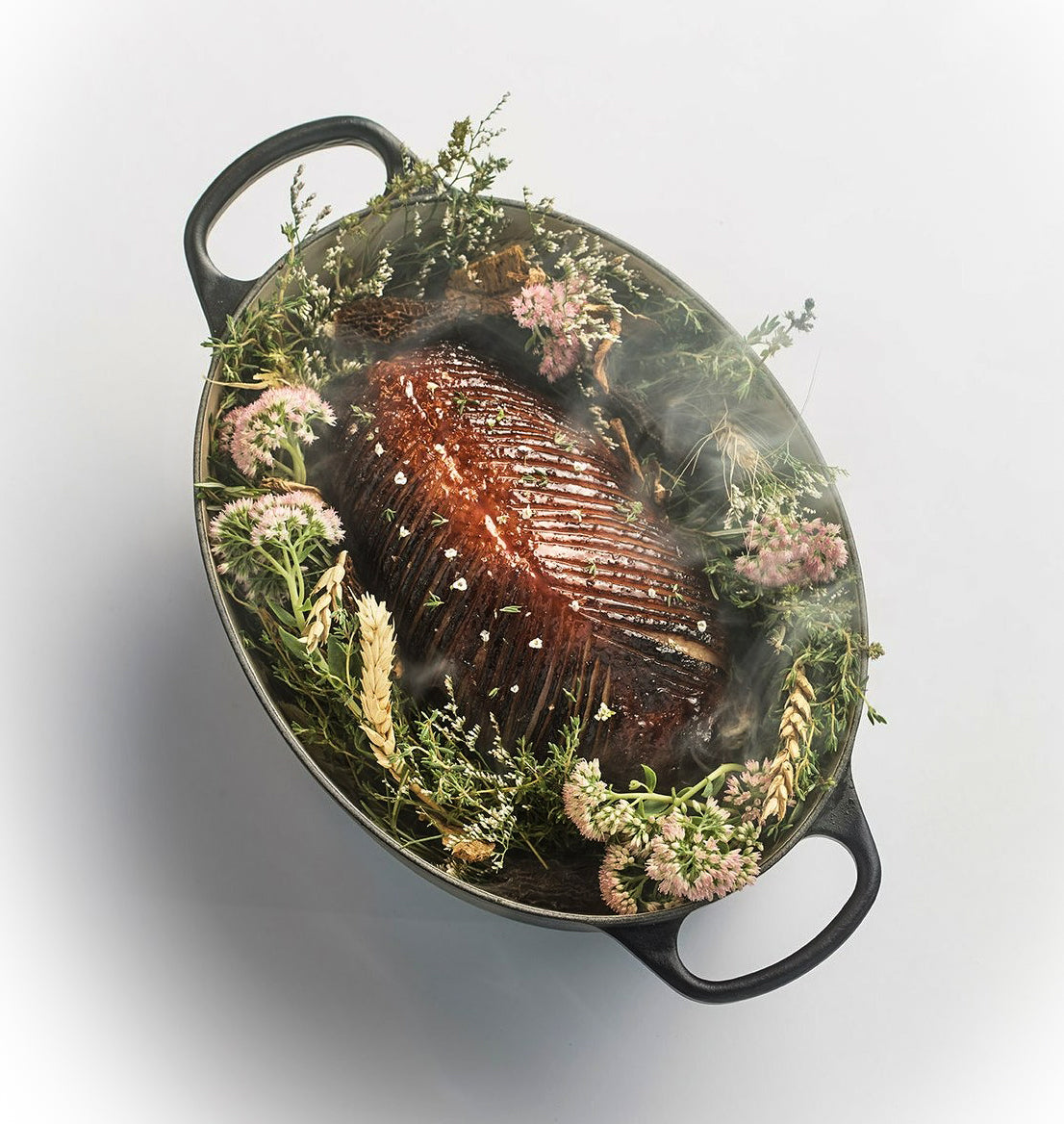
From Tathra Place to the Blue Mountains: crown-roasted duck glazed in Malfroy's Honey, served as part of the second tasting menu experience at Clare Smyth's Oncore in Sydney (Photo @oncore
| Instagram ) |
|
No longer want to receive these emails? {% unsubscribe %}
|
|
|
|
|